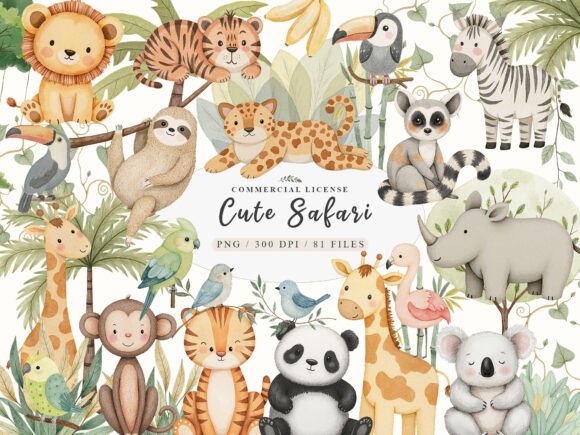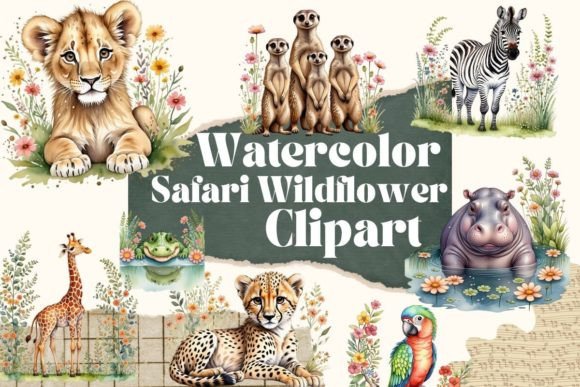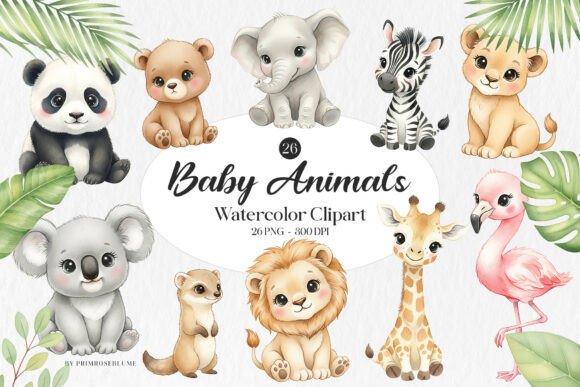
Baby Animals Watercolor Clipart
There is something instantly disarming about a baby animal rendered in soft, translucent watercolor washes. The medium itself—fluid, unpredictable, full of subtle gradients—mirrors the tenderness we associate with newborn creatures. Baby Animals Watercolor Clipart captures that delicate intersection of innocence and artistry, offering designers, small business owners, and content creators a visual shorthand for warmth, gentleness, and approachability. Unlike crisp vector icons or hyper-realistic photographs, these illustrations carry a handmade quality that feels personal and emotionally resonant. A pale blue bunny with fuzzy-edged ears or a sleepy fawn dissolving into a wash of sepia and ochre does not just decorate a page—it sets a mood, invites a pause, and signals that the person behind the project cares about the details.
The Visual Charm and Personality of Watercolor Baby Animal Art
The defining characteristic of Baby Animals Watercolor Clipart is its embrace of imperfection. Hard outlines are rare; instead, shapes emerge from pooled pigment, soft blooms, and subtle dry-brush textures. This gives each animal a living, breathing quality that flat digital illustration often lacks. A lamb might have a slightly uneven contour where the water bled into the paper texture, and a duckling’s wing might fade from cadmium yellow to ivory in a way that feels organic rather than mechanically graded.
This aesthetic works because it taps into a universal emotional cue: softness equals safety. The visual attributes—translucent layers, pastel-dominated palettes, gentle contrast—signal that the content is nurturing, non-threatening, and suitable for sensitive contexts. Designers working on nursery decor, baby shower invitations, or early childhood publications gravitate toward this style precisely because it communicates without shouting. The personality of these assets is quiet, reassuring, and deeply human. Even when used in commercial settings, the handmade undercurrent suggests authenticity and care, two qualities that digital-first audiences increasingly crave.
From a technical standpoint, modern watercolor clipart sets offer remarkable flexibility. Many collections include individual elements isolated on transparent backgrounds, allowing you to composite scenes without harsh white rectangles breaking the illusion. You might combine a sleeping kitten with scattered stars and a crescent moon, each element retaining its soft edge and paper texture. The best sets also provide multiple poses and angles—a fox curled up, a fox sitting, a fox peeking sideways—so you can build narratives rather than simply dropping in repetitive icons.
Branding and Identity for Family-Oriented Businesses
If you are building a brand around childcare, maternity, organic baby products, or family photography, Baby Animals Watercolor Clipart can become the cornerstone of your visual identity. A logo built around a watercolor hedgehog or a pair of nesting birds immediately telegraphs gentleness. When paired with a clean sans serif font or a soft handwritten font, the contrast between structured typography and fluid illustration creates a professional yet approachable brand mark. The texture of the watercolor adds depth that a simple graphic mark cannot replicate, and because the style is inherently artistic, it elevates the perceived value of the business. A diaper service using watercolor clipart signals premium attention to detail; a family counseling practice using the same assets conveys empathy and safety.
Editorial and Publishing Work
Children’s book illustrators and independent publishers often turn to watercolor clipart to supplement their own work or to prototype layouts quickly. The style integrates naturally with both serif fonts for traditional fairy-tale text and clean modern typography for contemporary storybooks. In editorial design—think parenting magazines, lifestyle blogs, or educational newsletters—these illustrations break up dense copy without overwhelming the reader. A watercolor otter peeking around a pull quote adds visual rhythm. In digital publications, the soft textures compress well for web use while retaining enough detail to feel substantial on retina screens.
Social Media Graphics and Digital Content
Social media feeds saturated with bold, high-contrast graphics benefit enormously from the breathing room that watercolor provides. Baby Animals Watercolor Clipart works beautifully for Instagram story backgrounds, Pinterest pins, and YouTube thumbnail accents. The low saturation and gentle edges draw the eye without triggering the visual fatigue that aggressive gradients or neon overlays can cause. Content creators covering pregnancy journeys, first-time parenting, or nature-based early education find that these illustrations reinforce their niche and make their posts instantly recognizable. A consistent clipart palette across a feed builds brand identity without feeling repetitive because each animal introduces subtle variation in shape and posture.
Packaging and Product Design
Packaging for organic baby food, natural skincare, or handcrafted toys often uses watercolor art to suggest purity and artisanal quality. Baby Animals Watercolor Clipart applied to labels, hang tags, or unboxing inserts creates a tactile impression even before the customer touches the product. The contrast between a modern sans serif or slim serif font and the soft illustration communicates that the brand respects both tradition and contemporary design. For small-batch makers, using clipart rather than commissioning original illustrations keeps costs predictable while maintaining a cohesive aesthetic across product lines.
How This Art Style Shapes Brand Perception and Audience Connection
The choice to use watercolor clipart rather than vector clipart or photography is a strategic decision about emotional tone. Vectors imply precision, efficiency, and modernity. Photography implies reality and documentation. Watercolor implies feeling, memory, and nurture. When a brand consistently uses Baby Animals Watercolor Clipart, it tells the audience: we value softness over sharpness, warmth over information density, and human touch over automated polish.
This perception loop is powerful. A parent scrolling through a website looking for a gentle sleep solution sees a watercolor lamb and registers safety before reading a single headline. A gift buyer browsing baby shower supplies sees a watercolor elephant and associates the product with care rather than commerce. Over time, the visual language becomes shorthand for the brand’s values. This is why thoughtful designers do not treat clipart as decorative filler. They treat it as a core element of brand identity, selecting sets that align with their audience’s emotional expectations and applying them consistently across touchpoints.
The readability and visual hierarchy also benefit from this style. Because watercolor illustrations have naturally lower contrast than hard-edged graphics, they recede slightly in the visual field. This makes them ideal for supporting roles—backgrounds, accents, framing devices—without competing with headlines or call-to-action buttons. A landing page for a parenting course can feature a watercolor bear curled around the hero text, guiding the eye inward without stealing the focus. The hierarchy remains intact: typography leads, imagery supports, and the overall composition feels cohesive rather than cluttered.
Evaluating Project Fit and Quality
Not every clipart set delivers the same level of usability. Look for collections that offer multiple resolutions—at least 300 DPI for print and well-optimized PNGs for digital use. Transparent backgrounds are non-negotiable unless you intend to place elements on white paper. Examine the color palette: does the set use a harmonious range of pastels and earth tones, or do the colors clash when placed together? The best sets feel cohesive because they were created with a limited palette. If you are designing for a specific brand, check whether the clipart aligns with your existing color strategy or if it introduces hues that will require you to adjust other assets.
Testing Font Pairings and Composition
Baby Animals Watercolor Clipart pairs naturally with several typography families. A soft handwritten font echoes the organic feel of the watercolor and creates a unified artisanal look. A clean sans serif font like a geometric or humanist style provides contrast and keeps the layout feeling modern. For more formal projects—such as a charity gala invitation featuring watercolor animal accents—a delicate serif font adds elegance without clashing with the informal subject matter. Test your pairings early. Place the clipart element next to the type and evaluate the relationship. If the font feels too rigid, the watercolor softness will look mismatched. If the font is too decorative, the composition becomes chaotic. Balance is everything.
Reviewing Included Styles and Compatibility
Some clipart sets include only full-color versions, while others offer black-and-white or monochrome variations. Having a grayscale option is valuable for print projects where color printing is not feasible, or for creating coloring pages as bonus content. Also check whether the set includes variations of the same animal at different angles. A set that offers only a single side-facing pose limits your layout options. A set with front-facing, side-facing, and sleeping versions of each animal gives you narrative flexibility. If you are designing a series—like a set of nursery prints or a monthly birth announcement template—you want enough variation to keep each piece fresh while maintaining visual consistency.
Understanding Licensing and Commercial Use
Before investing time in a design, confirm the licensing terms. Many clipart sets labeled for commercial use allow you to incorporate them into products for sale—such as invitations, mugs, or digital templates—but may restrict redistribution of the raw files. Some licenses require attribution; others do not. If you are a small business owner selling physical goods, make sure the license covers print-on-demand production and does not impose per-unit fees. For marketers creating branded content, check whether the license permits use in social media ads, email campaigns, and website design. Knowing the boundaries early prevents costly redesigns and legal headaches later.
Baby Animals Watercolor Clipart occupies a unique space in the design asset landscape. It is not as impersonal as a stock photograph, not as rigid as a vector icon, and not as expensive as a commissioned illustration. It offers a shortcut to emotional resonance without sacrificing professionalism. When chosen carefully and paired with thoughtful typography and composition, these soft, painterly creatures become more than decoration—they become the visual voice of a brand, the quiet anchor of a layout, and the detail that makes an audience feel truly seen.